


You don’t need a 12-step routine to make your skin look fresh before the day really gets going. A well-planned morning glow skincare routine can help your complexion look hydrated, smoother, and more awake by the time you head out the door. The secret is less about using every product on your shelf and more about putting a few useful steps in the right order.
Dermatologists generally recommend keeping a morning routine simple: cleanse, apply treatment when needed, moisturize, and finish with sunscreen. Consistency matters more than piling on products.
And yes, you can create a noticeable healthy-looking glow without making your morning routine feel like another chore.
Why Your Morning Routine Can Make Your Skin Look More Glowing
Morning skincare has a different job from your nighttime routine.
During the day, your skin needs protection from environmental exposure, especially ultraviolet radiation. At the same time, hydration can make the surface of the skin look smoother and more luminous.
Moisturizer, for example, helps trap water in the skin, which can improve the appearance of dryness and fine lines. Sunscreen, meanwhile, is essential for protecting skin from UV exposure that can contribute to premature aging and dark spots.
That means a good glow isn’t necessarily about making your skin shinier. It’s about creating a healthy-looking surface that is hydrated, comfortable, and protected.
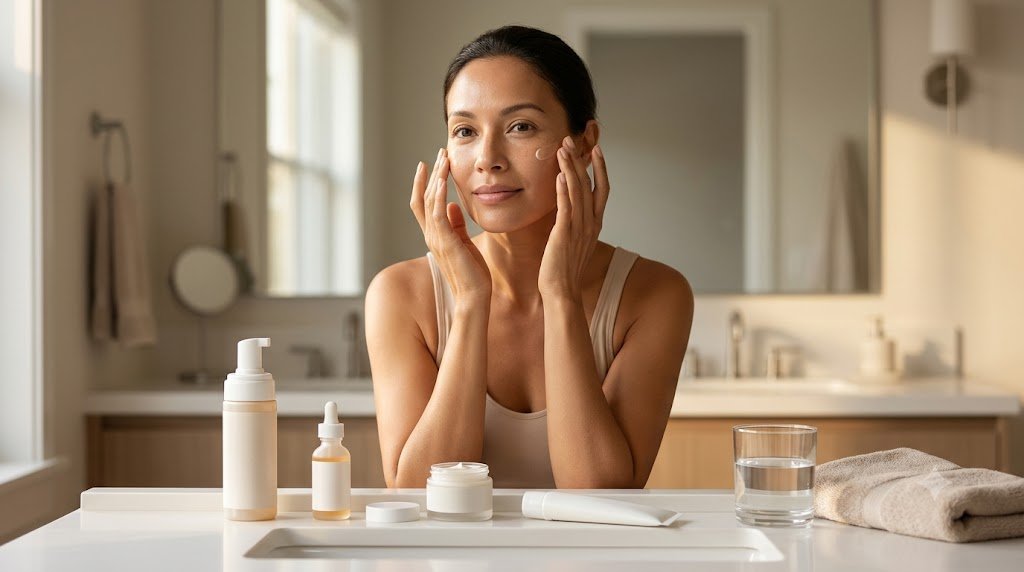
Morning Glow Skincare Routine: The Right Order
The order of your products doesn’t need to be complicated. In fact, Cleveland Clinic and the American Academy of Dermatology both support a relatively simple sequence built around cleansing, treatment, moisturizer, and sunscreen.
Step 1: Start With a Gentle Cleanser
Begin with a gentle cleanser to remove overnight oil, sweat, and residue.
You don’t need to scrub aggressively to get clean skin. Harsh cleansing or excessive washing can cause irritation, which isn’t helpful when your goal is a healthy-looking glow. The AAD recommends gentle, non-abrasive cleansing and notes that people with dry or sensitive skin may not need to wash their face frequently.
Use lukewarm water rather than very hot water, and pat your face dry instead of rubbing it.
If your skin feels tight immediately afterward, that’s a useful sign that your cleanser may be too drying for your skin type.
Step 2: Add a Targeted Serum
This is the optional part of your routine, but it can be useful if you want to address a specific concern.
Vitamin C is one popular choice for morning use. The AAD identifies vitamin C as an ingredient that can help improve the appearance of dark spots and signs of skin aging, and dermatologists commonly recommend applying it after cleansing and before sunscreen.
You don’t necessarily need vitamin C, though.
For some people, a simple hydrating serum may make more sense, particularly if dryness is the main reason their skin looks dull.
The key is to choose one targeted treatment rather than layering several active products simply because they are trending.
Step 3: Hydrate With Moisturizer
If your skin looks tired in the morning, dehydration may be part of the problem.
A good moisturizer can help skin hold onto water and create a smoother-looking surface. The AAD recommends moisturizing regularly and notes that applying moisturizer to damp skin can help trap water in the skin.
Choose a Formula Based on Your Skin
Dry skin: A richer cream may feel more comfortable.
Oily skin: A lightweight lotion or gel may be a better fit.
Combination skin: Use enough hydration for dry areas without overloading oily zones.
Sensitive skin: Keep the formula simple and consider fragrance-free options to reduce the chance of irritation.
Don’t assume that a heavy cream creates more glow. Sometimes a lighter layer gives you a fresher finish and sits better under makeup.
Step 4: Finish With Sunscreen
This is the step you shouldn’t skip.
Use a broad-spectrum sunscreen with SPF 30 or higher as the final step in your morning skincare routine. The AAD recommends broad-spectrum SPF 30+ sunscreen as part of everyday skin protection, while Cleveland Clinic also places sunscreen after moisturizer in the morning routine.
Sunscreen does more than protect against sunburn. Regular sun exposure contributes to premature skin aging and can worsen dark spots and uneven pigmentation.
If you’re spending significant time outdoors, reapply sunscreen according to the product instructions, typically every two hours and after swimming or sweating.
And don’t rely only on SPF in your foundation or moisturizer. A dedicated sunscreen is generally a more reliable approach to getting the protection your skin needs.
How to Get a Faster-Looking Glow Without More Products
Sometimes the quickest improvement comes from changing how you use your products rather than adding another one.
Apply Products to Slightly Damp Skin
After cleansing, don’t leave your face completely dry for a long time before moisturizing. Applying moisturizer to slightly damp skin can help trap water in the skin’s surface.
This is a particularly useful trick if your skin tends to feel tight or dull after washing.
Keep Product Layers Thin
A common mistake is applying a thick layer of every product.
Instead, use modest amounts and give each product a moment to settle before applying the next. This can make your routine feel lighter and can also help reduce pilling underneath makeup.
The goal is comfortable, hydrated skin-not a face covered in product.
Don’t Exfoliate Aggressively in the Morning
A rough scrub may make your skin feel immediately smooth, but repeated aggressive exfoliation can irritate the skin.
The AAD emphasizes gentle skincare and warns that using too many active products can lead to irritation.
For most people, your morning routine doesn’t need to include a physical scrub.
Read also: Clear Dark Spots Naturally for Smooth, Glass-Like Skin
What About Facial Mists, Toners, and Face Oils?
These products can be useful, but none is essential for creating a morning glow.
Toners are optional, and Cleveland Clinic notes that some formulas may be drying or irritating for sensitive skin. Face oils can also be too occlusive for some people and may contribute to acne in those who are prone to breakouts.
So, before adding another product, ask a simple question:
What problem am I trying to solve?
If the answer is “my skin feels dry,” a moisturizer may be more useful than another mist.
If the answer is “my skin looks uneven,” a targeted treatment may make more sense.
That keeps your routine purposeful instead of unnecessarily complicated.
How to Make Your Skin Look Glowier Before Makeup
A good morning skincare routine should work with your makeup rather than compete with it.
After applying your moisturizer and sunscreen, allow the layers to settle before applying foundation or concealer.
For a naturally luminous finish, use skincare that gives your skin enough hydration without leaving a heavy layer on the surface. A lightweight moisturizer paired with a suitable sunscreen can create a smoother base for makeup.
If your skin becomes oily quickly, avoid trying to create “glow” with thick oils. You may end up with shine instead of radiance.
There’s a difference.
Healthy-looking glow tends to look fresh and even. Excess surface oil can look greasy.
Can Vitamin C Make You Glow by 9AM?
Vitamin C can be a useful morning ingredient, particularly for people concerned about uneven tone and dark spots. However, it isn’t a magic overnight solution.
The AAD lists vitamin C among ingredients that can improve the appearance of dark spots and signs of skin aging, but skincare ingredients generally need consistent use over time rather than a single application to produce meaningful changes.
What you may notice immediately is the cosmetic effect of well-hydrated skin and a good moisturizer.
The longer-term benefits come from consistency.
So think of vitamin C as part of a routine, not your entire strategy for glowing skin.
Morning Skincare for Different Skin Types
Your glow routine should be adjusted to what your skin actually needs.
For Dry Skin
Focus on hydration. Use a gentle cleanser, a nourishing moisturizer, and sunscreen. A hydrating serum can be added if your skin still feels tight.
For Oily Skin
Keep the routine lightweight. A gentle cleanser, lightweight treatment, moisturizer, and non-comedogenic sunscreen can provide protection without making your skin feel overly coated.
For Sensitive Skin
Less is often more. Choose gentle, fragrance-free products and introduce new products one at a time. If a product consistently burns or stings, stop using it rather than assuming the irritation means it’s working. The AAD specifically recommends minimizing products that irritate the skin.
For Combination Skin
Use a balanced approach. You may need more hydration around the cheeks and less around the T-zone.
There is no rule saying your entire face has to receive exactly the same amount of every product.
Mistakes That Can Ruin Your Morning Glow
One of the biggest mistakes is doing too much.
Using several active ingredients at once can increase the chance of irritation. The AAD notes that more products are not necessarily better and that consistency with a simpler routine is often preferable.
Another mistake is skipping moisturizer because you have oily skin. Even oily skin can benefit from moisturizing; the key is choosing a formula appropriate for your skin type.
And then there is sunscreen.
Skipping it because your day “is mostly indoors” or because your makeup contains SPF can leave an important gap in your routine. Daily sun protection remains one of the most useful habits for maintaining healthy-looking skin.
Your 5-Minute Morning Glow Routine
When you’re in a rush, keep it simple.
Minute 1: Gentle cleanse.
Minute 2: Apply a vitamin C or hydrating serum if you use one.
Minute 3: Apply moisturizer.
Minute 4: Apply broad-spectrum SPF 30 or higher.
Minute 5: Let the products settle while you get ready, then apply makeup if you’re wearing it.
That’s enough.
You don’t need ten products, a complicated facial massage, or an hour in front of the bathroom mirror to have a thoughtful morning routine.
The goal is consistency.
Frequently Asked Questions
What is the best morning skincare routine for glowing skin?
A simple routine can include a gentle cleanser, one suitable treatment such as vitamin C, moisturizer, and broad-spectrum SPF 30 or higher. The exact products should be adapted to your skin type.
Can I get glowing skin in one morning?
You can make your skin look fresher and more hydrated in one morning, particularly with moisturizing skincare. However, longer-term improvements in pigmentation, texture, and signs of aging usually require consistent care over time.
Should I use vitamin C every morning?
Vitamin C is commonly used in morning routines and may help with dark spots and signs of skin aging. Whether you use it every morning depends on the specific product and how well your skin tolerates it.
Do I need moisturizer if I have oily skin?
Usually, yes. Oily skin can still become dehydrated. Choose a lightweight moisturizer that suits your skin and look for formulas labeled non-comedogenic when you’re concerned about clogged pores.
Why does my skin still look dull after skincare?
Dullness can have several causes, including dryness, irritation, uneven pigmentation, and lifestyle factors. Before adding more products, make sure your basics-gentle cleansing, moisturizing, and daily sunscreen-are consistent. If a persistent skin concern doesn’t improve, consider speaking with a dermatologist.
Conclusion
A morning glow skincare routine doesn’t have to be long to be effective. Start with gentle cleansing, add one targeted serum if you need it, keep your skin hydrated with moisturizer, and finish with broad-spectrum SPF 30 or higher.
For that fresh-by-9AM look, hydration is often more useful than piling on layers of makeup or trendy treatments. And while some products can give your complexion an immediate boost in appearance, the healthiest-looking glow comes from consistent habits over time. Keep your routine simple, protect your skin every morning, and let the results build gradually.